
GenSci secures $1.37B deal with Yarrow for first-in-class TSHR antibody
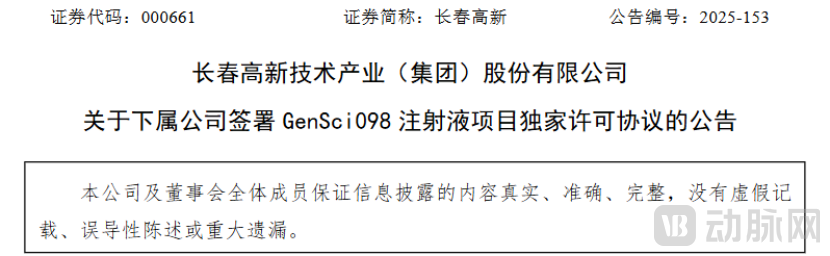
On December 15, Changchun High-Tech (stock code: 000661) announced that Shanghai Scizeng Medical Technology (Scizeng Medical), a subsidiary of its majority-owned subsidiary Changchun GeneScience Pharmaceutical (GenSci), has entered into a global exclusive licensing agreement (excluding Greater China) with U.S. biopharmaceutical company Yarrow Bioscience, Inc. for the GenSci098 Injection project.
According to the agreement terms, GenSci will receive an upfront payment of $120 million and near-term development milestone payments. It is also eligible to receive up to $1.365 billion in cumulative milestone payments based on R&D, regulatory, and commercial progress. Additionally, upon product launch, GenSci will receive tiered royalties exceeding 10% based on net sales.
GenSci098: From Mechanism Breakthrough to Dual Indication Coverage
GenSci098 Injection is the core asset of this transaction. This novel drug, independently developed by GenSci, is a humanized Thyroid Stimulating Hormone Receptor (TSHR) antagonistic monoclonal antibody, classified as a Category 1 (innovative) therapeutic biological product in China.
TSHR is a G protein-coupled receptor (GPCR) located on the surface of thyroid cells and orbital-related tissues. It plays a key regulatory role in the synthesis and secretion of thyroid hormones, as well as in thyroid cell proliferation. Previous studies have shown that the persistent activation of TSHR by pathogenic autoantibodies is a significant pathological basis for the development of Graves' disease (GD) and the inflammation and tissue remodeling seen in Thyroid Eye Disease (TED).
However, existing treatments primarily focus on symptom management of thyroid disorders. While anti-thyroid drugs serve as the first-line therapy, they are associated with a high relapse rate upon discontinuation and carry safety risks such as agranulocytosis and liver function impairment. Radioactive iodine therapy and surgical resection, although effective in rapidly controlling hyperthyroidism, often lead to permanent hypothyroidism, necessitating long-term hormone replacement therapy. For TED, conventional treatments show limited efficacy in improving proptosis and achieving long-term inflammatory control, resulting in a persistent unmet clinical need.
Within this treatment landscape, the R&D strategy for GenSci098 directly targets the upstream disease mechanism. By specifically binding to TSHR in the thyroid and retro-orbital tissues and blocking its interaction with thyroid-stimulating hormone or pathogenic stimulating autoantibodies, GenSci098 can inhibit the synthesis and release of thyroid hormones, reduce thyroid cell hyperplasia, and simultaneously decrease the release of hyaluronic acid and inflammatory cytokines. This shared molecular target enables its development strategy to concurrently cover both GD and TED—two related yet long-separated indications.
In terms of development progress, GenSci098 has entered the clinical development stage for multiple indications. In August 2024, the product received approval from the National Medical Products Administration (NMPA) to conduct clinical trials for TED in China. It also obtained an implied IND approval from the FDA during the same period, enabling synchronized advancement in both China and the U.S. (Announcement Nos.: 2024-083, 2024-093). In October 2025, GenSci098 further received approval in China to initiate clinical trials for GD, extending its development focus from ocular complications to the systemic disease itself.
GenSci: From Growth Hormone Leader to Full-Spectrum Innovation Platform
The global licensing of GenSci098 is not an isolated event, but rather a milestone achievement resulting from GenSci's over two decades of continuous efforts to upgrade its R&D system and restructure its pipeline. It also exemplifies GenSci's strategic transformation from a single-product leader into a comprehensive innovative pharmaceutical company.
As a majority-owned subsidiary of Changchun High-Tech, GenSci was founded in 1997. It initially established its leadership in the field of pediatric growth and development in China by breaking the import monopoly with recombinant human growth hormone, thereby building a solid commercial foundation and industry reputation. Building upon this success, GenSci has in recent years accelerated the reallocation of resources towards innovative drugs, decisively moving beyond dependence on a single product. It has established a multi-platform, multi-disease area R&D framework, now encompassing diverse technological pathways including macromolecular drugs, small molecule drugs, small nucleic acid therapies, and cell and gene therapies. Its business scope has expanded from its core areas of child health and endocrine/metabolic disorders to therapeutic fields with significant unmet clinical needs, such as immunology, oncology, dermatology, and ophthalmology.
According to publicly available information, GenSci employs nearly 10,000 people, markets over 30 products, and has more than 80 innovative drug candidates in its pipeline. GenSci has established a fully integrated industry chain covering R&D, manufacturing, and commercialization.
In 2025, GenSci's innovative pipeline entered a phase of intensive validation: In the autoimmune field, Firsekibart for Injection (brand name: Jinbeixin) was approved for the acute gouty arthritis indication. As one of China's first anti-IL-1β biologics, this approval marked a key breakthrough in a non-traditional core therapeutic area for the company. In the field of oncology supportive care, the nanocrystalline megestrol acetate product Megaxia® was approved for cancer-related anorexia-cachexia, addressing a treatment gap in this specific niche in China. Its core growth hormone business continues to advance through technological iterations and indication expansion, further solidifying its market leadership.
While the licensing partner, Yarrow Bioscience, is a relatively new company, it is backed by RTW Investments, a globally recognized life sciences investment firm renowned for incubating innovative healthcare companies. RTW is distinguished by its deep scientific insight and investment acumen, focusing on the early-stage support and industrialization of transformative projects in biopharmaceuticals. As an RTW incubation vehicle, Yarrow's core mission is to advance the global development and commercialization of candidate therapies with breakthrough potential.
Yarrow's selection of GenSci098 reflects not only the recognized market potential in thyroid disorders but also confidence in the drug's differentiated profile. There are few drugs with the same target and overlapping indications. Publicly, the most advanced direct competitor is K1-70, followed by a few other TSHR small molecule antagonists in early-stage development.
Targeting a Niche TSHR Pathway, Pioneering a Tiered Licensing Strategy
As a pivotal achievement of GenSci's strategic transformation over the past decade, the global licensing path of this TSHR-targeting monoclonal antibody showcases the company's ability to secure a strong position in a specialized niche. It also highlights a broader industry shift from chasing crowded "hot-targets" to a value-driven pursuit of niche pathways.
By selecting TSHR—a target within the endocrinology field—GenSci consciously avoided the highly congested oncology and immune checkpoint inhibitor arenas, focusing instead on thyroid disorders, a segment with globally shared unmet medical needs. According to a Wiseguy Reports research publication, the thyroid disease market was valued at USD 4.36 billion in 2024 and is projected to reach USD 7.45 billion by 2032, representing a compound annual growth rate (CAGR) of approximately 6.92% during the forecast period from 2025 to 2032.
More importantly, the incidence of thyroid diseases shows a relatively balanced distribution across regions like North America, Europe, and the Asia-Pacific, with no significant geographic disparity. This homogeneity allows clinical data generated from GenSci098's concurrent trials in China and the U.S. to directly support multi-market regulatory approvals worldwide, significantly reducing the clinical translation costs associated with global expansion.
The structure of this deal particularly underscores the growing leverage of Chinese pharmaceutical companies in out-licensing. It is no longer a simple all-rights deal but a sophisticated arrangement designed to maximize value through precise rights segmentation, risk hedging, and a tiered revenue-sharing mechanism. The agreement explicitly stipulates that GenSci retains full development and commercialization rights in Greater China, licensing only the ex-China markets to Yarrow Bioscience. This approach safeguards GenSci's access to the high-potential Chinese market while leveraging the partner's clinical resources and commercial networks in the U.S. and Europe to circumvent localization barriers inherent in independent global expansion. Furthermore, the deal grants GenSci a tiered royalty exceeding 10% on net sales in the licensed territories, structuring long-term commercial returns that extend beyond upfront and milestone payments, thereby ensuring the company participates in the future growth of global markets.
For industry observers, the significance of this event extends far beyond its immediate financial return. It provides a tangible, executable blueprint. It clearly demonstrates how a Chinese biopharma company can enter the global market by avoiding overcrowded fields and focusing on a differentiated target, how to balance domestic interests with international expansion through sophisticated deal architecture, and how to gain recognition from global capital based on solid R&D and clinical capabilities. As more robust pipelines from China advance into global clinical and commercial stages, the role of Chinese drug innovation in the global pharmaceutical value chain is likely to become increasingly prominent.