
MSTP completes nearly 100 million funding round to advance Chinese commercialization of novel medical isotopes
MSTP recently announced the completion of a nearly 100 million angel-round financing. This round was led by Casstar, with co-investment from Shuri Chenxing and Zhengjing Capital, and Index Capital served as the exclusive financial advisor. The raised funds will be primarily used for the construction and equipment installation of the company's Mianyang medical isotope production base, aiming to achieve the commercial supply of innovative alpha-emitting and beta-emitting nuclides such as Ac-225, Pb-212, and Cu-67 by the end of 2026. This effort will advance China's new medical isotope industry from "technological breakthroughs" toward "standard leadership and independent, stable supply."
Founded in 2019, MSTP focuses on breakthroughs in the production processes and industrialization of medical isotopes, striving to become a leading medical isotope supplier in China. The MSTP team brings together experts in nuclear physics, radiochemistry, high-energy accelerators, radiation safety, and related fields. Founder Zhang Quanshi, who previously conducted long-term research on radiodiagnosis of radioactive isotopes at the Northwest Institute of Nuclear Technology, first proposed the technical approach for producing isotopes such as Mo-99 via electron accelerator photonuclear reactions in 2006 and has since conducted related theoretical and experimental studies.
Isotopes such as Ac-225 are currently highly regarded as innovative medical radionuclides but face challenges including a global supply shortage and a lack of domestic availability in China. MSTP employs the electron accelerator photonuclear reaction method to produce Ac-225, which is the preferred technical route adopted by internationally leading companies for the large-scale commercial production of Ac-225, such as NorthStar, Pantera, Niowave, and Full-Life. The selection of this technological path by MSTP is not only based on the team's decades of deep technical expertise but also due to its advantages of high yield, low radioactive toxic byproducts, and low production costs.
In 2024, with approval from authorities including the China Atomic Energy Authority, MSTP participated as a national representative in the International Atomic Energy Agency (IAEA) "Technical Meeting on Implementation of the Global Radium-226 Management Initiative" and was invited to deliver a keynote presentation titled "Repurposing Legacy Radium-226 Radiation Sources," sharing technologies for radium source transmutation disposal and radon gas management. At the meeting, MSTP publicly disclosed for the first time its process technology capable of simultaneously producing two medical isotopes, Ac-225 and Pb-212, from a single irradiation target. MSTP's presentation garnered significant attention and led to collaboration intentions with relevant international companies and radium source management organizations.
To date, MSTP has filed over 30 patents in fields such as isotope production and separation, covering core processes and related equipment, including target material processing, photonuclear reaction-based production, target recovery, separation and purification, and hazardous byproduct management. Based on comprehensive proprietary technology, MSTP has established a complete isotope production process platform, enabling the production of innovative medical isotopes such as Ac-225, Pb-212, Cu-67, and Sc-47.
In 2025, led by MSTP and in collaboration with leading Chinese Ac-225 and Pb-212 drug R&D teams including the Shanghai Institute of Materia Medica, Chinese Academy of Sciences, Southwest Medical University, C-ray Therapeutics, and North Sichuan Medical College, MSTP co-established two group standards: "Actinium-225 Nitrate Solution" and "Lead-212 Nitrate Solution." These group standards specify requirements for isotope nuclear purity, testing methods, storage conditions, and other critical parameters, filling the gap in production and supply standards for these two medical isotopes in China. This milestone lays the foundation for future commercial supply and integration with Chinese and international radiopharmaceutical industry clients.
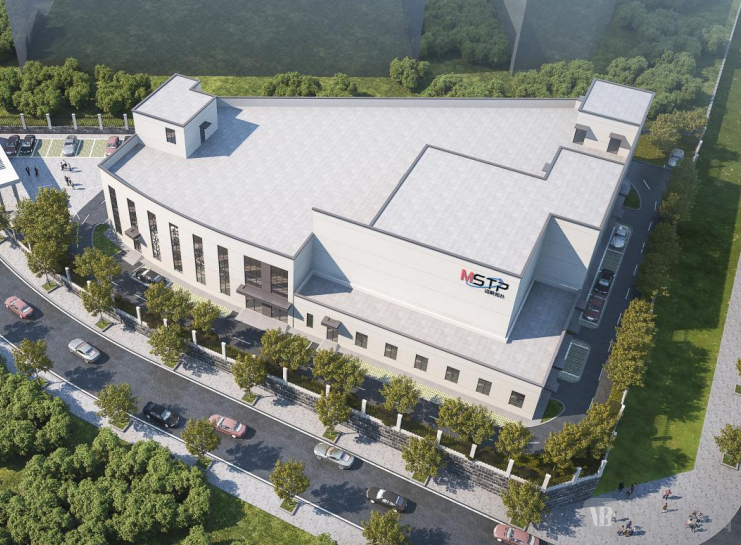
MSTP's Mianyang production base obtained a Class A environmental impact assessment (EIA) approval in November 2024, making it the first project in China to receive such top-level EIA approval involving the handling of radioactive radium and radioactive radon gas. In October 2025, the GMP-grade medical isotope production base in Mianyang completed its concrete pouring and roof sealing. Key equipment, including electron accelerators and hot cells for process lines, has been gradually delivered and installed according to schedule. Currently, the application materials for the Class A radiation safety license have been submitted, with approval expected in the second quarter of 2026. MSTP plans to complete production line commissioning in the first half of 2026, followed by trial production of nuclides such as Ac-225, Pb-212, and Cu-67 in the second half of the year.
MSTP has established strategic partnerships with key enterprises across China's radiopharmaceutical industry chain, including SmartNuclide (Suzhou), Ablaze Pharmaceuticals (Shanghai), C-ray Therapeutics (Chengdu), AB-RayBio Therapeutics (Hangzhou), Qinshan Nuclear Power, and listed companies. These collaborations have secured future demand for over 50 curies (Ci) of related isotopes. Concurrently, MSTP was ranked first in the "Sichuan Province Nuclear Medicine Full Industry Chain Breakthrough Project – Industry Category" in 2025, receiving approximately RMB 25 million in special state-allocated funding support.